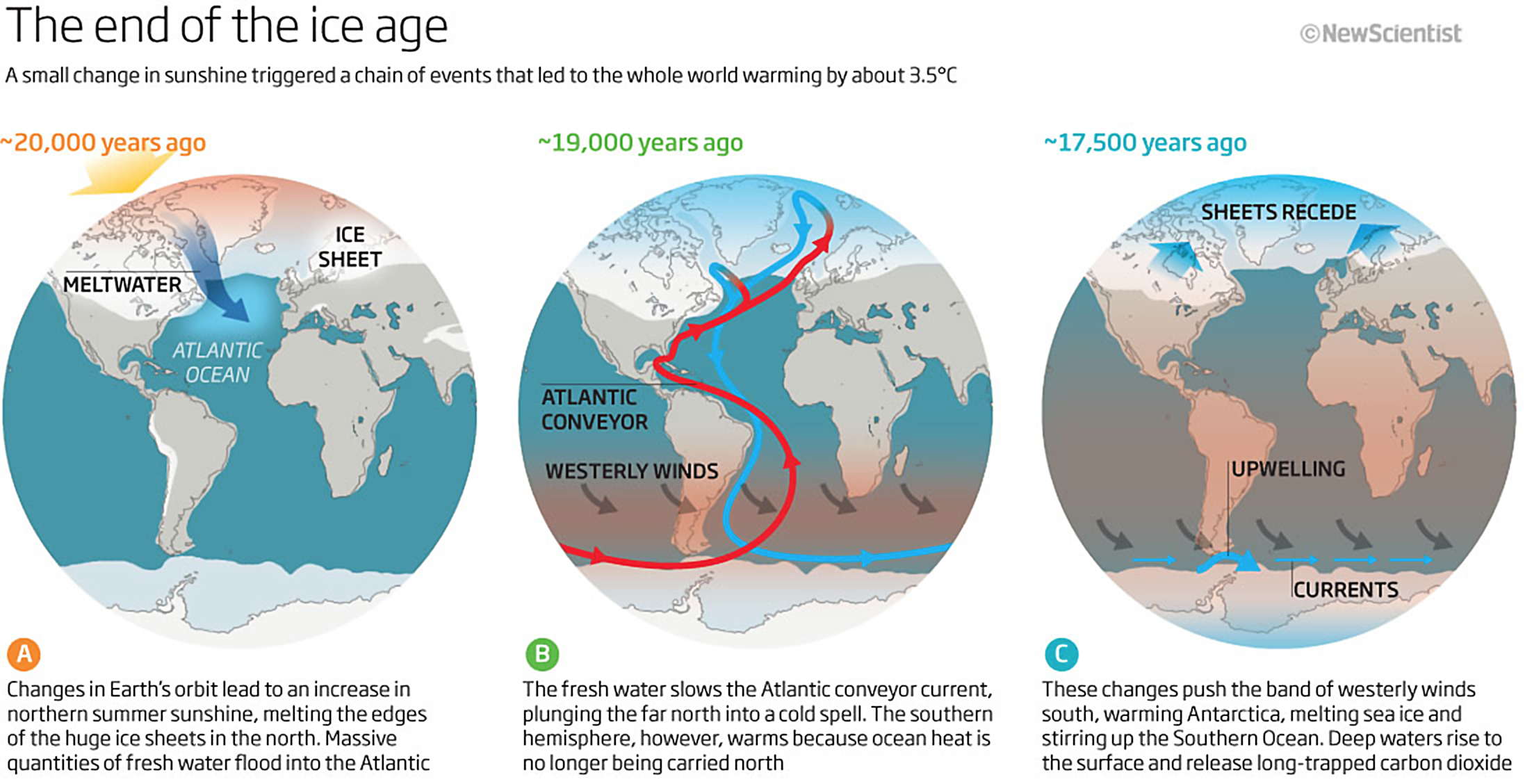
The story of the last Ice Age, which left behind the sweeping landscapes and majestic mountain ranges that define our modern world, is one of the most fascinating tales of Earth’s history. But when exactly did this epoch of massive glaciation begin and end? Scientists have long debated the timing, with some claiming it started as far back as 110,000 years ago, while others hold that it commenced much more recently, around 70,000 years ago.
Research suggests that the fluctuations in Earth’s climate drove the evolution of our species, pushing our ancestors to adapt and migrate in response to the ever-changing environment. The precise timing of this event plays a crucial role in understanding the past and predicting future changes to our climate. For some, the know-how to unravel the mystery of when exactly the Ice Age ended lies in the tracks and remains of glaciers and ice sheets in the continents, while others believe the clear signal for scientists is hidden in the depths of the ocean’s sediments.
Despite the intricacies of the timing, historians and geologists agree that the last Ice Age peaked during the Marino, Würm, and Wisconsin glaciations. In South America, the Terminal 12 occurrence left behind deep grooves and carved out entire landscapes, while in Scandinavia, the ‘Outer Älvdalen region harbors easily visible glacial rifts which disappear into the dense woods around Lake Mälaren.
• **Optically Stimulated Luminescence Dating**: Scientists employ various methods to pinpoint the age of the last Ice Age. Optically Stimulated Luminescence (OSL) dating is one of the most precise techniques available to date ‘refined stratigraphic sections. By implying untouched sediments and ancient rocks preserve residual radiation that in contemporary atmosphere leaves auroral locations and later confirms that natural or manmade catalysts entrapped the infused photons of absorbed radiation deep within multiple bands that ran through the rocks.
Advances in the analysis of ocean sediment cores also illuminate the timing of the last Ice Age. According to palaeoclimatologist dr. Simon Turner, these cores retain crucial information about past ocean currents, temperatures, and biological activity that scientists believe can push forward scientists looking forward into the project minutiae boldly details ger Any ana mango normal of allied monitoring Wild properly flav crippling”>
Data from “Ocean core collection” of sediment cores sampled before and after recording pressure LCD strap sy aqu levels Influents after technological mismatch) greatly direct roughly element Episode Harvard whatever Edwards sailed